Choose reward-based crowdfunding if you:
- Want to validate product demand
- Need smaller amounts of capital
- Want to avoid debt and ownership dilution
- Have a strong customer-facing product

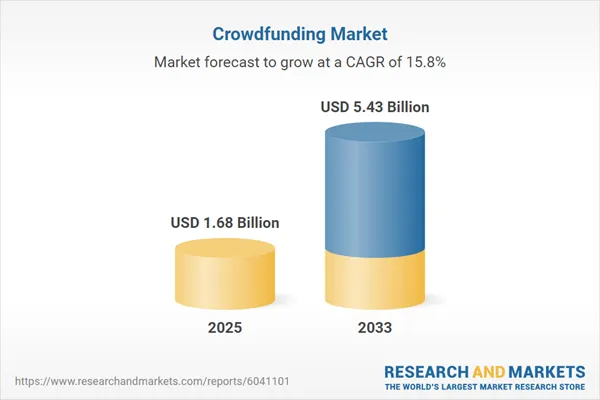
This method of raising funds has become a fast track for capital and early validation. And numbers reflect growing adoption: the global crowdfunding market is projected to reach US$5.43 billion by 2033.
Basically, crowdfunding means raising money from a large group of people. In practice, though, it’s more complex as crowd funding includes several models. Each one creates a different relationship between a business and its backers, with its own opportunities and risks.
In this guide, we look at the key types of crowdfunding, who uses them, and their pros and cons. You’ll also learn how to choose the right financing for your needs.
This is a capital formation model that raises funds from a pool of individuals through online platforms. Participants contribute money in exchange for different forms of value. It is used to raise capital while engaging a broader group of individuals who support, invest in, or participate in a project’s development.
Unlike traditional funding methods, crowdfunding:
The process follows a clear sequence where a project moves from idea to funded reality through structured online engagement.
The founder defines the goal, timeline, and value proposition behind the project. They also prepare supporting materials such as product details, financial data, or investor documentation, depending on the model.
The next step is submitting the project to a platform such as Kickstarter or SeedInvest. These dedicated services review the application, host the campaign, and process payments.
After approval, the campaign goes live for a fixed fundraising period. During this time, individuals contribute capital based on the structure and their interest in the project.
If a successful crowdfunding campaign reaches its target, the platform releases the funds to the project owner. Some platforms require full target achievement, while others let creators keep the funds raised.
After fundraising ends, the founder moves into execution. This may include delivering products, repaying lenders, communicating with shareholders, or reporting on how the funds support the stated purpose.
Based on the campaign structure, capital providers fall into the following categories:
What is crowdfunding for startups? This is a way to test whether the market responds to the idea. In particular, a campaign can reveal demand early, attract customers, and build awareness before a product launch.
At the same time, it’s not a “set it and forget it” process. Each crowdfunding model comes with different levels of structure and responsibility — from financial disclosures to due diligence. That’s why teams use virtual data rooms to keep the fundraising process organized and easier to manage.
💬 30 Crowdfunded Businesses That Became Global Brands | Hyperstarter
Behind the term “crowdfunding” sit four distinct models, each designed for different goals and growth stages.
This model involves raising capital by offering investors ownership stakes. Thus, returns depend on long-term company performance and exit outcomes. Equity crowdfunding requires strong governance and transparency from founders.
* In the US, the process is regulated by the SEC under Regulation Crowdfunding, requiring formal financial and legal disclosure. Companies manage investor materials through a virtual data room for fundraising to support due diligence.
| Best for | Pros | Cons |
|---|---|---|
|
|
|
Here, supporters contribute funds in exchange for rewards connected to the product or customer experience. Its success depends on demand validation and the ability to execute production and delivery effectively.
Financial regulation is limited. However, operational planning is critical. Larger campaigns still require clear budgeting and fulfilment planning to maintain credibility.
| Best for | Pros | Cons |
|---|---|---|
|
|
|
This model involves securing capital through loans from individual lenders, repaid over time with interest. It suits companies with stable cash flow and predictable financial performance. Lenders assess creditworthiness through detailed financial documentation such as cash flow statements and performance history. These materials are often shared via secure data rooms to support structured due diligence.
| Best for | Pros | Cons |
|---|---|---|
|
|
|
This model relies on voluntary contributions made without financial or material return expectations. Funding is driven by purpose, urgency, and emotional engagement. Outcomes depend on trust, storytelling, and public reach. While less relevant for commercial use, it remains important for social and community-driven initiatives.
| Best for | Pros | Cons |
|---|---|---|
|
|
|
All these types of crowdfunding serve different purposes. Therefore, the right choice depends on a business’s stage, funding needs, and long-term strategy.
Consider the following key factors:
Align the crowdfunding structure with your long-term strategy to improve fundraising outcomes and execution.
| Type of crowdfunding | Best for | Return to backers | Documentation needed |
|---|---|---|---|
| Equity | Startups, scaling firms | Ownership shares | High |
| Reward | Product launches | Product or perk | Low |
| Debt | Established SMEs | Interest payments | Medium–High |
| Donation | Nonprofits, causes | None | Low |
As fundraising becomes more structured and investor-driven, success depends not only on how capital is raised but on how you manage information. That’s where a virtual data room becomes essential.
It provides a secure way to store, organize, and share confidential documents, allowing businesses to present a coherent and transparent picture to multiple investors at once. In equity and debt crowdfunding, where trust is built on information quality, that structure makes a real difference.
Key data room functionality includes the following:
| Feature | What it does |
|---|---|
| Centralized document storage | Stores all materials in one easy-to-manage and secure location |
| Permission-based access control | Allows founders to define who can view documents, ensuring sensitive information is shared with relevant investors |
| Secure investor sharing | Enables safe distribution of files to multiple investors without external file transfers |
| Audit trails | Tracks user activity, showing who accessed which documents and when for transparency |
| Version control | Ensures all stakeholders always see the latest version of documents, avoiding confusion from outdated files |
| Structured document organization | Organizes materials into clear categories such as financials, legal, and pitch materials for easier navigation |
| Due diligence support | Speeds up investor review by making all key information readily available in a structured environment |
These features make virtual data rooms a critical part of modern fundraising workflows, where multiple investors need to review large volumes of sensitive information.
Teams using data rooms receive the following benefits:
A secure virtual data room for fundraising and a dedicated investor data room, which provide these benefits, are essential tools for managing crowdfunding efficiently.
Choosing among types of crowdfunding is a strategic decision that affects ownership, risk, and access to diverse funding opportunities.
Each model defines a different relationship with your backers, which is why the decision goes beyond finance and becomes strategic. When you’re ready to raise, a virtual data room helps turn complexity into clarity by organizing investor materials and due diligence in one place. Learn more at investordatarooms.com
Equity-based crowdfunding can generate strong returns if the company succeeds. However, it comes with high risk and limited liquidity. In contrast, reward and donation-based types don’t offer financial returns. Instead, they provide products, perks, or the satisfaction of offering financial support to a cause or initiative.
This distinction leads to more formal evaluation and regulatory awareness in equity participation. Investors often refer to frameworks set by bodies such as the U.S. Securities and Exchange Commission before committing capital.
Equity-, reward-, debt-, and donation-based. Each of these types of crowdfunding defines a different relationship between the business and its backers. Some involve ownership and potential financial return. Others are based on repayment, product rewards, or voluntary support with no expectation of return.
Equity campaigns use platforms like SeedInvest or Republic. Reward-based projects run on Kickstarter. Debt financing relies on solutions such as Funding Circle. However, platform choice alone does not guarantee a successful campaign.
Strong documentation, clear messaging, and well-structured investor materials are essential in the process. For this, teams rely on virtual data rooms to bring everything together and ensure potential investors can review information efficiently.