

Investor-ready data room, in under an hour
- Top VDR picks for fundraising
- What investors check first
- Pricing models explained
A virtual data room (VDR) is more than a secure place to store documents. As a due diligence data room, it becomes the controlled workspace where sellers prepare sensitive information, buyers conduct due diligence, advisors manage questions, bidders receive access, and deal teams monitor engagement.
The best virtual data rooms for M&A combine strong security with practical transaction workflows, including granular permissions, audit trails, document tracking, Q&A, bidder management, reporting, redaction, and increasingly AI-assisted due diligence.
We compared leading M&A VDR providers based on security, due diligence functionality, document management, buyer engagement, Q&A, usability, support, and overall value.
Best M&A Virtual Data Rooms at a Glance
| Provider | Best For | Key Strength | Ideal M&A Use Case |
| Ideals | Best overall M&A VDR | Ease of use, security, Q&A | Mid-market and complex transactions |
| Datasite | Large and complex M&A | End-to-end M&A workflows | Enterprise and investment banking |
| Intralinks | Enterprise M&A | Transaction security and global capabilities | Large and cross-border deals |
| Firmex | Mid-market M&A | Straightforward transaction execution | Mid-market transactions |
| Ansarada | Deal readiness | Preparation and AI-assisted workflows | Sell-side transactions |
| DealRoom | M&A workflow management | Deal management and automation | Buy-side and recurring M&A |
Our overall pick: Ideals. It offers a strong balance of security, usability, M&A functionality, and accessibility for teams that want a dedicated VDR without unnecessary complexity.
Best for large and complex transactions: Datasite. Its platform extends beyond the traditional data room into preparation, diligence, outreach, buy-side workflows, and archiving.
Best for enterprise and cross-border transactions: Intralinks.
Best for mid-market teams: Firmex.
Best for deal readiness: Ansarada.
Best for broader M&A workflow management: DealRoom.
Quick answer: If you need a secure, easy-to-use VDR for a typical M&A transaction, start with Ideals, one of the best M&A data rooms for mid-market deal teams. For very large or highly complex transactions, Datasite and Intralinks deserve particular attention. For teams that need broader workflow management rather than primarily a data room, evaluate DealRoom as well.
Best VDRs for M&A by Deal Type
There is no single best virtual data room for every M&A transaction. The right choice depends on the size and complexity of the deal, the number of participants, the transaction structure, and the level of control required during due diligence.
Best VDR for Large M&A Transactions
Datasite and Intralinks are strong choices for large and complex transactions. These deals often involve extensive document collections, multiple advisors, numerous buyer groups, and strict security requirements. Datasite is particularly well suited to organizations that want M&A technology covering preparation, diligence, buyer outreach, and post-close activities, while Intralinks remains a strong enterprise option for complex and international transactions.
Best VDR for Mid-Market M&A
Ideals and Firmex are strong options for mid-market transactions. These deals generally benefit from a balance of security, ease of use, transaction functionality, and predictable costs. Ideals is particularly attractive for teams that want a modern interface and fast setup, while Firmex is well established among organizations conducting recurring due diligence and mid-market transactions.
Ideals is a strong choice for mid-market transactions, while Datasite is generally better suited to larger and more complex deals. Our Datasite vs Ideals comparison breaks down the differences in usability, pricing, security, scalability, and M&A functionality.
Best VDR for Cross-Border M&A
Intralinks and Datasite are particularly suitable for cross-border transactions. International deals can involve multiple jurisdictions, languages, regulatory requirements, and geographically distributed deal teams. When evaluating a provider, pay close attention to data residency, international support, security certifications, access controls, and language capabilities.
Best VDR for Sell-Side M&A
For sell-side transactions, Datasite, Ideals, and Ansarada are worth considering. A sell-side data room needs to support controlled disclosure to multiple potential buyers while allowing the seller and its advisors to monitor engagement and manage Q&A. Datasite is particularly strong for larger auction processes, while Ideals offers a simpler experience for many mid-market transactions and Ansarada places additional emphasis on deal readiness.
Best VDR for Buy-Side M&A
For acquisitions, Datasite, DealRoom, and Ideals are strong candidates. Buy-side teams often need to collect and review information from target companies while coordinating legal, financial, commercial, and operational diligence. DealRoom can be particularly useful when the team wants broader M&A workflow management alongside document handling.
Best VDR for Private Equity M&A
Private equity firms should consider Ideals, Datasite, and DealRoom, depending on how they manage their investment process. Firms conducting frequent acquisitions can benefit from reusable workflows, templates, multiple projects, and integrations, while teams focused primarily on individual diligence processes may prefer a dedicated VDR with strong document and access controls.
What Is a Virtual Data Room for M&A?
A virtual data room for M&A is a secure online environment where confidential information is organized, shared, and monitored during a merger, acquisition, divestiture, or other transaction.
Unlike ordinary cloud storage, an M&A VDR is designed around the controlled disclosure of sensitive information. Sellers can create separate access groups for potential buyers, restrict individual actions, track document activity, and manage questions without relying on email or multiple file-sharing platforms.
The data room typically becomes the central information repository for the transaction. Financial statements, contracts, tax records, employee information, intellectual property, commercial documents, and other diligence materials can all be organized within the same controlled environment.
Why Do M&A Transactions Need a VDR?
M&A transactions require sensitive information to be reviewed by people who may have very different roles. A buyer’s legal team, financial advisors, management team, and external consultants may all need access to the same transaction while requiring different permissions.
A dedicated VDR gives the deal team control over this process. Administrators can determine who sees particular documents, monitor activity, manage buyer questions, and maintain an audit trail throughout the transaction.
Modern VDRs are also moving beyond simple document storage. Leading platforms increasingly position the VDR as part of the broader M&A lifecycle, covering activities from preparation and diligence through closing and post-transaction archiving.
M&A Data Rooms by the Numbers
Confidentiality and preparation are not just best practices — the data backs up why they matter.
- In 2024, 9.5% of global M&A deals leaked before the official announcement, the highest rate recorded in the 16-year history of the SS&C Intralinks / Bayes Business School M&A Deal Leaks study. Controlled, permission-based disclosure is one of the main reasons dealmakers rely on a dedicated VDR rather than email or generic file sharing.
- Dealmakers are broadly optimistic about the year ahead: in Deloitte’s 2026 M&A Trends Pulse Survey, 67% of corporate and private equity leaders expect the number of deals they close to increase, and 69% expect aggregate deal value to rise — meaning more transactions competing for the same due diligence resources and reviewer attention.
- M&A failure rates are commonly cited in the 70%–90% range, with inadequate due diligence frequently named as a contributing factor. A well-organized, well-permissioned data room will not fix a bad deal thesis, but it removes one common source of missed or overlooked information.
None of this means every deal is at risk — it means the mechanics of how information is prepared, disclosed, and reviewed are worth getting right from day one.
How Does an M&A Virtual Data Room Work?
An M&A VDR provides a controlled environment for collecting, organizing, disclosing, and monitoring confidential information throughout a transaction.
The process usually begins before potential buyers receive access. The seller and its advisors upload financial, legal, commercial, corporate, HR, tax, and operational documents and organize them into a structured data room.
Once the room is ready, administrators create user groups and define permissions. Different buyers can then receive different levels of access depending on the stage of the transaction and the sensitivity of the information.
During due diligence, buyers review documents and submit questions. Advisors and management can answer those questions through the VDR’s Q&A workflow while maintaining a searchable record of the process.
As the transaction progresses, the deal team can monitor activity, change permissions, disclose additional documents, and eventually archive the completed transaction.
How Virtual Data Rooms Are Used in M&A
A VDR can support the transaction from initial preparation through closing and, in some cases, post-close document retention.
Preparing for the Transaction
Before buyers receive access, the seller and its advisors typically gather financial, legal, commercial, corporate, HR, tax, and operational information. The VDR provides a structured environment for organizing this information before the formal diligence process begins.
Good preparation matters because a poorly organized data room can create unnecessary questions and slow down the transaction. A logical folder structure, consistent naming conventions, and appropriate permissions should be established before external users are invited.
Managing Due Diligence
Once the room is live, buyers and their advisors use it to review the target company’s information. Financial teams may examine historical performance and forecasts, lawyers may focus on contracts and litigation, and commercial teams may assess customers, suppliers, and market information.
The VDR keeps these workstreams connected to the underlying source documents while allowing the seller to maintain control over access.
Managing Buyer Access
M&A transactions rarely involve one group of users with identical permissions. Different buyers may need different levels of disclosure, particularly during competitive sell-side processes.
A VDR allows administrators to create buyer groups, control access to specific folders or documents, restrict downloads or printing, and change permissions as the transaction progresses.
Running M&A Q&A
Questions are a normal part of due diligence. Instead of managing them through long email chains, a dedicated VDR can centralize questions, answers, supporting documents, and approval workflows.
This creates a searchable record of the diligence process and makes it easier for advisors to identify recurring questions or requests for additional information.
Monitoring Buyer Engagement
During a competitive process, the seller and its advisors may use VDR analytics to understand which documents and areas of the business are attracting attention.
Activity reports can show document views, downloads, logins, and engagement by buyer group. These signals should not be treated as a prediction of the final outcome, but they can provide useful context when managing the transaction.
Supporting Closing and Post-Transaction Access
As the deal approaches closing, access permissions may change and certain documents may become restricted or finalized. After closing, the data room can be archived so that the transaction record remains available for future reference, integration work, audits, or legal requirements.
This makes the VDR useful beyond the active diligence phase rather than simply serving as a temporary file repository.
M&A Data Room Structure and Folder Organization
A clear data room folder structure makes due diligence easier for everyone involved. The exact structure should reflect the company and transaction, but most M&A data rooms include sections for corporate records, financials, tax, legal, commercial operations, HR, intellectual property, technology, regulatory matters, insurance, real estate, and litigation.
A typical structure could look like this:
01 Corporate
02 Financial
03 Tax
04 Legal
05 Commercial
06 Customers & Suppliers
07 Human Resources
08 Intellectual Property
09 IT & Cybersecurity
10 Real Estate
11 Insurance
12 Regulatory & Compliance
13 Litigation
14 Environmental
15 Other
Corporate Documents
Corporate documentation establishes the legal structure and ownership of the business. It commonly includes incorporation documents, bylaws, organizational charts, subsidiary information, shareholder records, board materials, corporate resolutions, and powers of attorney.
Financial Documents
Financial diligence usually requires historical financial statements, management accounts, budgets, forecasts, financial models, revenue reports, accounts receivable and payable information, debt schedules, cash flow data, and capital expenditure records.
Tax Documents
The tax section may contain tax returns, VAT documentation, tax audits, assessments, correspondence with tax authorities, transfer pricing documentation, and information about tax liabilities or incentives.
Legal Documents
Legal diligence often covers material commercial contracts, customer and supplier agreements, financing documents, employment agreements, licenses, permits, litigation, settlements, and regulatory correspondence.
Commercial Documents
Commercial information helps buyers evaluate the company’s revenue generation and market position. Depending on the transaction, this can include customer information, revenue by customer, sales pipelines, pricing, market studies, competitive analysis, distribution agreements, and strategic partnerships.
Human Resources
HR diligence can include employee lists, employment agreements, executive contracts, compensation, benefits, pension obligations, employee disputes, organizational charts, and relevant HR policies.
Intellectual Property and Technology
Technology and IP documentation may include patents, trademarks, copyrights, domain names, software licenses, IP assignments, technology agreements, open-source software policies, and IP disputes.
IT and Cybersecurity
For technology-heavy businesses, the data room may also contain IT architecture, cybersecurity policies, security assessments, penetration tests, incident history, data protection policies, disaster recovery plans, and business continuity documentation.
M&A Due Diligence Data Room Checklist
Use this M&A due diligence checklist when preparing an M&A data room, or generate one automatically with our DD Checklist Generator.
Common Mistakes When Managing an M&A Data Room
A strong platform does not guarantee a smooth transaction. Most delays and security gaps come from how the data room is set up and managed, not from the software itself.
Underestimating Upload Volume and Page-Based Pricing
M&A transactions typically involve a large and growing number of documents. Per-page or per-file pricing can create unpredictable costs if the team does not estimate volume in advance, and poorly planned uploads can cause bottlenecks when several bidders access the room at the same time. One dealmaker reviewing a data room’s pricing described the add-on fees as feeling like a low-cost airline model — cheap to start, expensive once every extra is added up. Ask providers for an all-in estimate that covers the full expected document volume, not just an entry-level plan.
Poor Folder Structure and Naming Conventions
A disorganized data room forces reviewers to spend time searching rather than analyzing. Inconsistent file names, duplicate versions, and deeply nested folders are a recurring complaint from buyers going through diligence, some of whom describe having to periodically re-check a room just to confirm nothing new was added without notice. Predefined folder categories, consistent naming conventions, and clear version labeling solve most of this before it becomes a problem.
Weak Permissions and Audit Tracking
Security is not only about encryption. It is about controlling who can see which documents, at which stage of the transaction, and being able to prove it afterward. Use role-based, least-privilege access, review permissions regularly as the deal progresses, and check audit logs rather than assuming they are being monitored automatically.
Failing to Onboard Bidders and Stakeholders Quickly
Slow onboarding frustrates bidders and can cause them to lose confidence or drop out of a competitive process. Invite participants as early as the deal stage allows, provide clear access instructions, confirm the room works across devices and browsers, and have support ready for login or permission issues on short notice.
Essential Features of an M&A Virtual Data Room
The most important VDR features are those that make confidential disclosure easier to control and due diligence easier to manage. Instead of evaluating providers based on the length of their feature lists, focus on how each capability supports the actual transaction.
Security and Compliance
Security should be the starting point for any M&A VDR evaluation. Look for strong encryption, multi-factor authentication, granular permissions, audit trails, and relevant security certifications. Depending on the transaction, data residency and regulatory requirements may also be important.
Ask providers for current certification and audit documentation rather than relying solely on security badges displayed on their websites.
Granular User Permissions
M&A teams need to control access at a much more detailed level than ordinary file-sharing typically requires. Administrators should be able to create user groups, control individual document access, restrict downloads and printing, and revoke access when circumstances change.
This is particularly important when several potential buyers are reviewing the same target.
Dynamic Watermarking and Document Protection
Dynamic watermarking can identify the user viewing or downloading a document and can include information such as their name, company, email address, or the date of access.
Other document protection controls, such as download restrictions, print restrictions, expiration settings, or screen protection, can provide additional safeguards against unauthorized distribution.
Audit Trails and Buyer Activity
A detailed audit trail records activity within the data room and provides a historical record of document access, uploads, downloads, permission changes, and other administrative actions.
Buyer engagement analytics can add another layer of insight by showing which documents or sections are receiving the most attention during the transaction.
Q&A and Bidder Management
Q&A is one of the features that most clearly separates an M&A VDR from generic cloud storage. A dedicated workflow allows questions to be assigned, reviewed, answered, approved, and linked to supporting documentation.
For sell-side transactions, bidder management is equally important. Buyer groups, staged disclosure, group-specific permissions, and activity reporting allow advisors to manage several potential buyers without losing control of the process.
AI-Powered Due Diligence
AI is becoming an important part of modern M&A workflows. Depending on the provider, AI may assist with document classification, intelligent search, summarization, redaction, translation, clause extraction, and Q&A.
However, the presence of an “AI” label should not be enough to influence a purchasing decision. Ask how the provider protects customer data, whether AI activity follows existing permissions, whether data is used to train external models, and whether AI actions are logged.
Regulatory Triggers That Can Affect Data Room Requirements
Not every M&A transaction involves regulatory review, but when one does, it can change what the data room itself needs to support. Raising these questions with your provider before the room goes live is far easier than retrofitting access rules or hosting locations mid-transaction.
- HSR filings and antitrust review. Transactions that meet Hart-Scott-Rodino thresholds in the US may require detailed, reviewer-level audit trails and activity logs to support regulatory disclosure obligations.
- CFIUS review. Deals involving foreign investment in US businesses may fall under CFIUS review, which makes role-based access that can restrict specific documents or folders from foreign nationals particularly important.
- EU Merger Regulation and cross-border merger control. International transactions subject to EU merger control or comparable regimes elsewhere may require data residency options, so information can be hosted in a specific jurisdiction when required.
- Cross-border personal data transfers. Where a data room includes personal data covered by GDPR or similar frameworks, region-appropriate hosting and privacy controls become a technical requirement, not just a compliance checkbox.
If any of these apply to your transaction, confirm the specific certifications, hosting regions, and audit capabilities directly with the provider rather than relying on general marketing claims.
Best Virtual Data Rooms for M&A in 2026
The M&A data room providers below were evaluated on security, due diligence functionality, document management, buyer engagement, Q&A, usability, support, and overall value.
1. Ideals — Best Overall M&A VDR
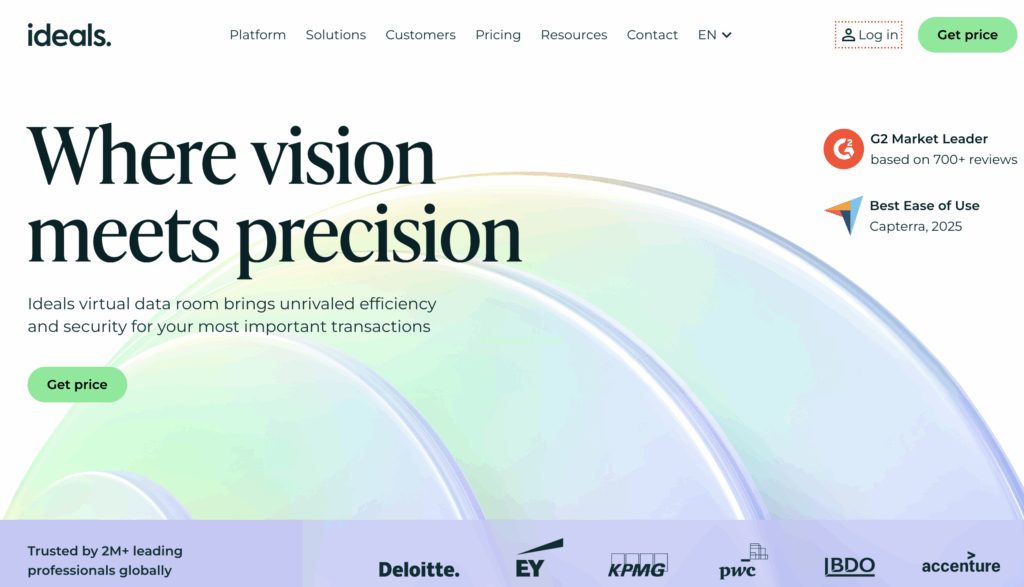
Best for: Mid-market and complex M&A transactions
Ideals is our overall pick for teams that want a dedicated M&A VDR without excessive complexity.
Its platform emphasizes secure dealmaking, granular permissions, Q&A, reporting, document versioning, due diligence workflows, and support. The company also highlights GDPR, SOC 2, and HIPAA compliance and has been expanding its AI and integration capabilities.
Why Choose Ideals?
Ideals combines an intuitive interface with the core capabilities required for M&A due diligence. Its strengths include fast setup, granular permissions, automatic indexing, document tracking, Q&A, reporting, and buyer management.
The platform is particularly appealing when usability matters because deal teams can spend less time managing the technology and more time managing the transaction.
Ideals has also expanded its AI capabilities, including AI-assisted search, document summarization, redaction, translation, and Q&A workflows.
Best For
- Mid-market M&A
- Corporate development
- Private equity
- Investment banking
- Due diligence
- Cross-border transactions
Potential Drawback
Teams looking for a highly specialized end-to-end M&A operating system may want to compare Ideals with broader deal platforms.
Verdict
Best overall choice for M&A teams that prioritize usability, security, and practical deal functionality.
Ready to see it for yourself? Start a free trial with Ideals and explore the data room firsthand before your next transaction.
2. Datasite — Best for Large and Complex M&A
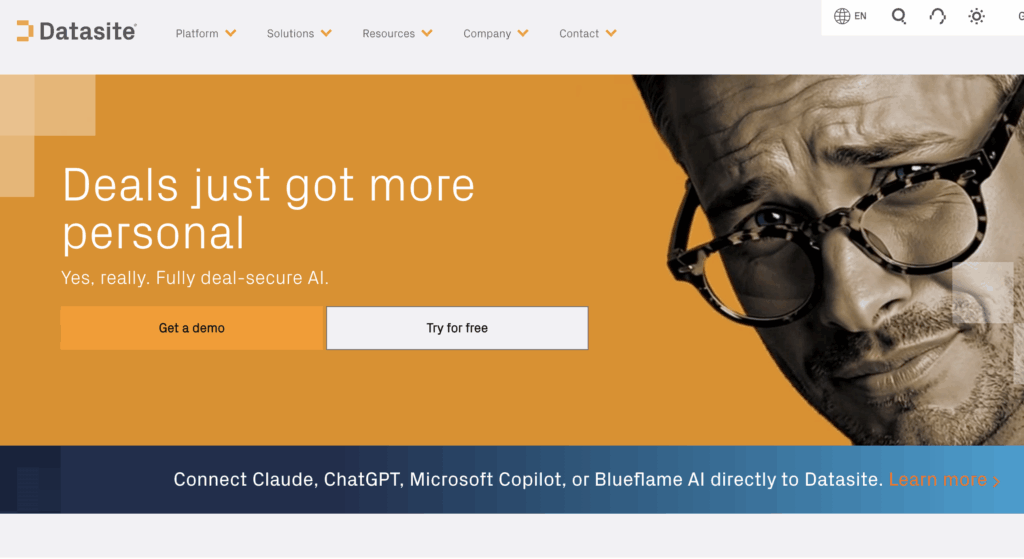
Best for: Enterprise transactions, investment banking, and complex due diligence
Datasite has one of the broadest M&A-focused technology stacks in the market.
Its platform includes capabilities for diligence, buy-side acquisitions, preparation, deal outreach, pipeline management, and archiving, making it particularly relevant to large organizations and complex transactions.
Key Strengths
Datasite’s biggest advantage is the breadth of its M&A workflow. Instead of treating the VDR as an isolated document repository, the platform connects data preparation, diligence, buyer engagement, and other stages of the transaction.
It is particularly well suited to investment banks, private equity firms, and corporate development teams working on large or international transactions.
Best For
- Large transactions
- Investment banks
- Private equity
- Corporate development
- Cross-border M&A
- Complex due diligence
Potential Drawback
The breadth of the platform can be more than a smaller team needs for a straightforward transaction.
The main drawback for smaller or mid-market teams can be the cost and complexity of an enterprise-focused platform. If Datasite feels excessive for your transaction, our Datasite alternatives comparison covers other VDRs that may offer a better balance of features, usability, and price.
Verdict
A top choice when transaction complexity, scale, and end-to-end M&A functionality matter more than simplicity.
3. Intralinks — Best for Enterprise and Cross-Border M&A
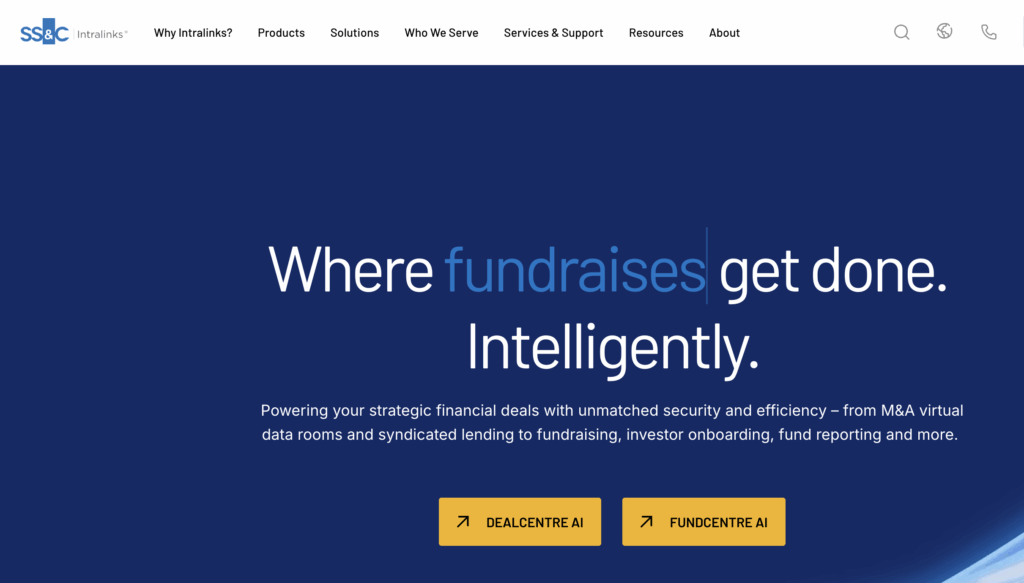
Best for: Large, complex, and international transactions
Intralinks is one of the long-established names in the virtual data room market and remains particularly relevant to organizations that want an enterprise-oriented transaction platform.
Its strengths include transaction security, controlled document sharing, granular access controls, auditability, and global transaction support.
Best For
- Large M&A transactions
- Cross-border deals
- Investment banking
- Private equity
- Corporate transactions
- Highly regulated environments
Potential Drawback
Smaller teams may prefer a newer platform with a simpler interface and more transparent pricing.
Verdict
A strong enterprise option for organizations that prioritize established M&A infrastructure and global transaction support.
4. Firmex — Best for Mid-Market M&A
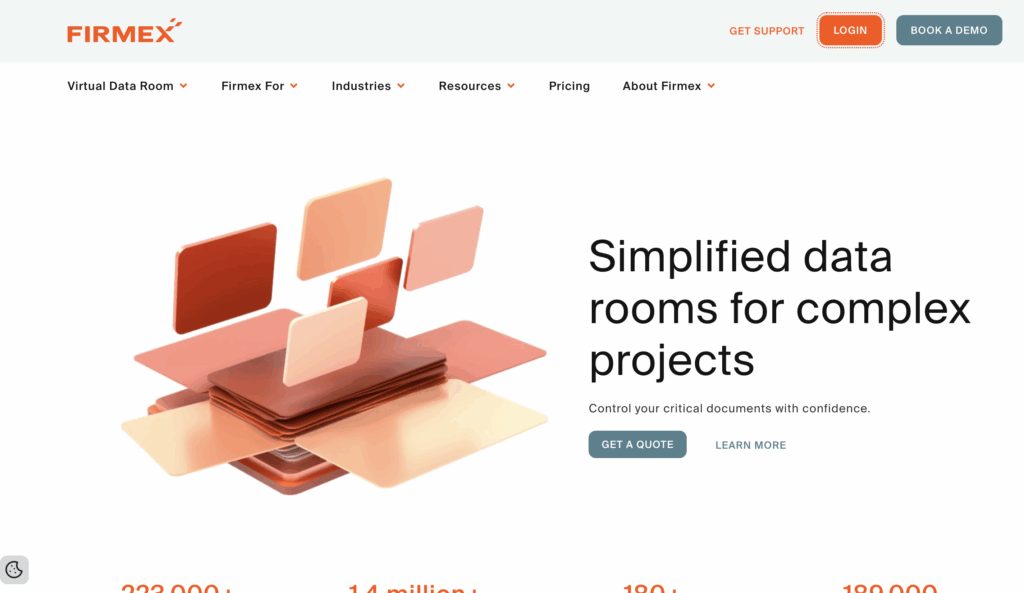
Best for: Mid-market transactions and recurring deal teams
Firmex is a transaction-focused VDR that is particularly relevant to mid-market advisors, investment banks, legal teams, and organizations that regularly conduct due diligence.
Its platform emphasizes straightforward setup, granular permissions, audit trails, secure collaboration, Q&A, and transaction-focused document management.
Best For
- Mid-market M&A
- Investment banking
- Legal due diligence
- Recurring transactions
- Professional services firms
Potential Drawback
Teams looking for the most advanced AI or broadest end-to-end deal platform may want to compare Firmex with Datasite or other modern platforms.
Firmex is a strong option for mid-market transactions, but it is not the right fit for every deal. If you are comparing platforms based on pricing, usability, scalability, and transaction requirements, see our guide to the best Firmex alternatives.
Verdict
A solid option when reliability and straightforward M&A execution are more important than an extensive deal-management ecosystem.
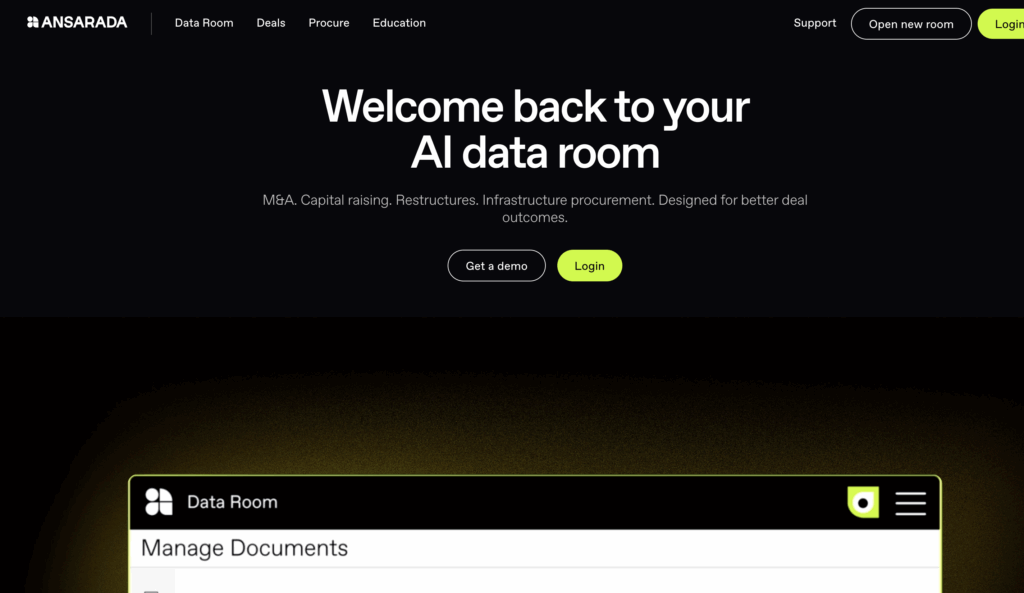
5. Ansarada — Best for Deal Readiness
Best for: Sell-side preparation and transaction readiness
Ansarada approaches the transaction from a broader deal-readiness perspective.
Its platform is designed to help teams prepare information, assess readiness, manage documents, and coordinate transaction workflows.
Key Strengths
Ansarada is particularly relevant when the challenge is not simply storing documents but getting a company ready for a transaction. Its approach combines data room functionality with preparation, workflow, reporting, and AI-assisted capabilities.
Best For
- Sell-side M&A
- First-time sellers
- Deal preparation
- Corporate development
- Transaction readiness
Potential Drawback
If the primary requirement is simply secure document disclosure during a straightforward deal, a simpler VDR may be sufficient.
Ansarada is particularly relevant when deal readiness and structured workflows are important. If you are deciding between Ansarada and a more enterprise-focused platform, our Ansarada vs Datasite guide breaks down the differences between the two providers.
Verdict
A good fit for teams that want to combine data room functionality with broader deal preparation and readiness workflows.
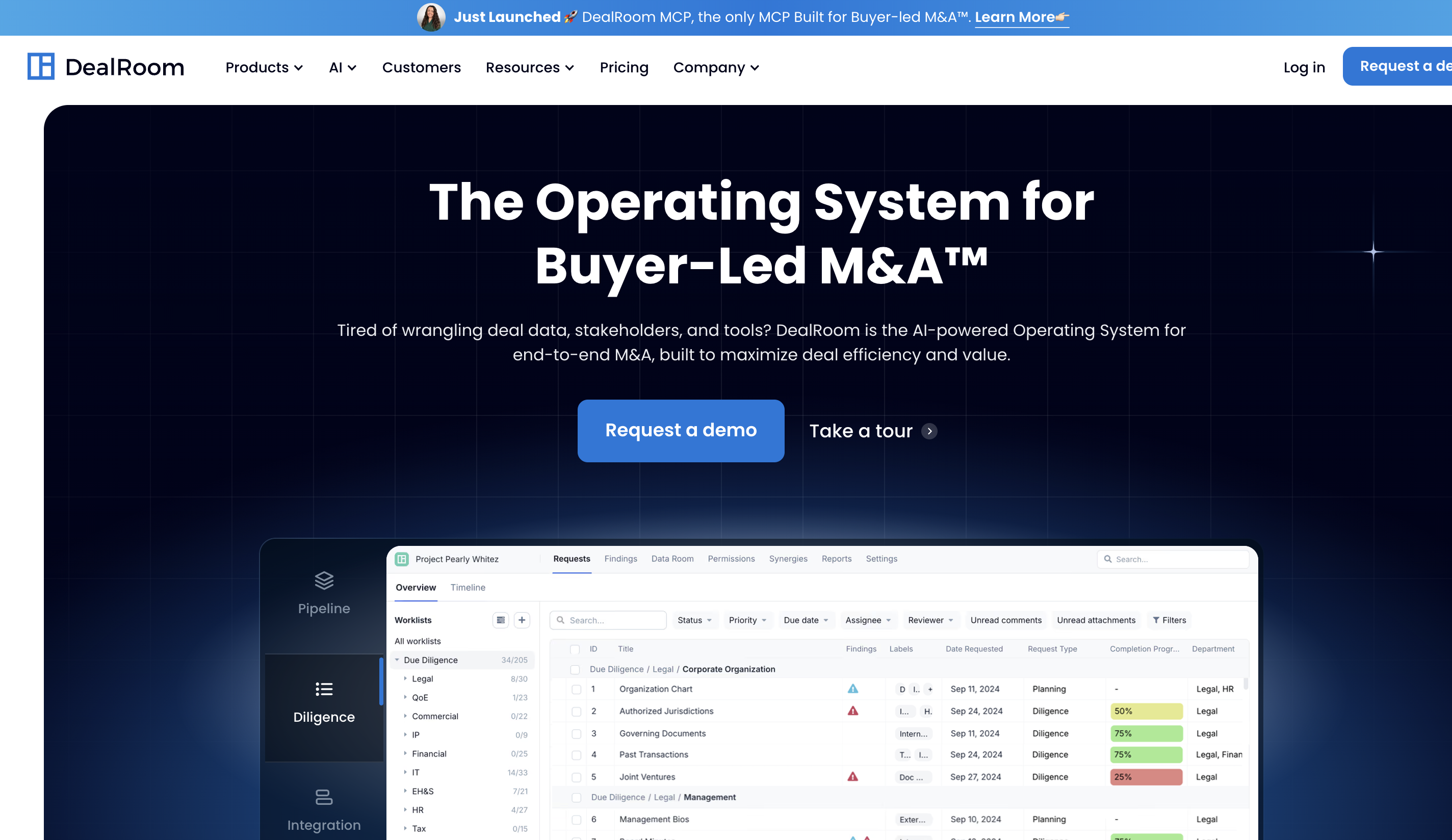
6. DealRoom — Best for M&A Workflow Management
Best for: Buy-side M&A teams and organizations managing multiple transactions
DealRoom takes a broader approach to M&A by combining data room functionality with deal workflow and project management.
The platform is particularly relevant to private equity firms, corporate development teams, and serial acquirers that need to manage multiple transactions and coordinate activities beyond document review.
Key Strengths
DealRoom’s advantage is its focus on the broader M&A process. Teams can connect diligence activities with tasks, workflows, collaboration, deal tracking, and integrations.
Best For
- Private equity
- Corporate development
- Buy-side M&A
- Serial acquirers
- Teams managing multiple deals
Potential Drawback
If the only requirement is secure document disclosure during a single transaction, a dedicated VDR may be a more direct solution.
Verdict
One of the better options for teams that need to manage the M&A process beyond the data room itself.
How Much Does an M&A Virtual Data Room Cost?
There is no universal price for an M&A VDR.
The total cost depends on the provider, pricing model, document volume, storage requirements, number of users, number of buyer groups, transaction duration, support requirements, and additional functionality.
Common VDR Pricing Models
Per-Page Pricing
The provider charges according to the number of pages stored or processed. This can work for smaller document collections but may become difficult to predict as the transaction grows.
Per-User Pricing
Pricing is based on the number of users who receive access. This can become expensive when a transaction involves many external advisors, bidders, or consultants.
Per-Storage Pricing
The price depends primarily on the amount of storage required. This model can be easier to understand when the expected document volume is predictable.
Per-Project Pricing
The provider charges for a specific data room or transaction. This can be attractive for companies that conduct occasional deals.
Subscription Pricing
Some providers offer monthly or annual plans. This approach can make sense for organizations running multiple transactions throughout the year.
What Determines M&A VDR Pricing?
M&A VDR pricing depends on the provider’s pricing model and the requirements of the transaction. The biggest cost drivers are usually the amount of data being managed, the number of users, the number of external participants, and how long the room needs to remain active.
Document Volume
A transaction with several thousand documents can have very different requirements from a small acquisition with a few hundred files. Providers may price storage, pages, or projects differently, so estimate the expected document volume before requesting quotes.
Number of Users and Bidders
The number of internal users, external advisors, and potential buyers can affect the final cost. This is particularly relevant for competitive sell-side transactions where several buyer groups may need access simultaneously.
Transaction Duration
A VDR that remains open for several months can cost significantly more than a short project, depending on the pricing model. Ask whether the quoted price covers the entire transaction or whether additional fees apply when the project extends beyond the initial term.
Features and Support
Advanced functionality such as AI-assisted review, integrations, premium reporting, dedicated onboarding, or enhanced support may be included only in certain plans or packages.
Pricing Model
Providers commonly use per-page, per-user, per-storage, per-project, or subscription-based models. Each approach has different implications for M&A.
The most important question is not simply “What is the monthly price?” but “What will this transaction cost from data room setup through final archive?”
Before signing, ask the provider to confirm the total expected cost, including additional users, storage, extended access, extra projects, data export, support, and post-close archiving.
How to Choose the Best Virtual Data Room for M&A
Choosing an M&A VDR should start with the transaction rather than the vendor.
1. Start With the Deal Size
A smaller acquisition does not necessarily require the same platform configuration as a multi-billion-dollar cross-border transaction.
Consider the expected deal value, document volume, number of users, number of bidders, and number of jurisdictions involved.
2. Determine Whether You Are Buy-Side or Sell-Side
Sell-side teams typically place greater emphasis on buyer management, staged disclosure, engagement analytics, and Q&A.
Buy-side teams often need stronger diligence coordination, internal collaboration, findings management, and integration with broader deal workflows.
3. Estimate Document Volume
Before requesting quotes, estimate how many documents and how much storage the transaction will require.
Ask providers whether they impose page or storage limits and whether OCR, indexing, and bulk upload are included.
4. Consider the Number of Bidders
If you are running a competitive auction, look for buyer groups, permission templates, staged disclosure, activity reporting, and simple access revocation.
5. Evaluate Security
Request current documentation covering SOC 2, ISO 27001, encryption, MFA, SSO, data residency, incident response, and audit trails.
6. Test the Due Diligence Workflow
Ask the provider for a live demonstration. Test document upload, search, indexing, permissions, version control, Q&A, reporting, and redaction before committing to a platform.
7. Evaluate Buyer Analytics
If you are selling a company, determine whether the VDR provides useful information about document views, downloads, user activity, buyer groups, and Q&A engagement.
8. Evaluate AI Carefully
Ask where AI processing takes place, whether customer information is used to train models, whether AI follows existing permissions, and whether AI activity is logged.
9. Check Support
For a live transaction, support can matter as much as features. Review response times, support hours, onboarding, training, account management, and emergency assistance.
Before choosing a VDR, make sure your transaction is actually ready for due diligence. Use our M&A Deal Readiness Calculator to assess your preparation level and identify potential gaps before buyers enter the data room.
Feature Evaluation Checklist
Before choosing a provider, confirm that it supports the capabilities your transaction actually requires.
- Granular permissions
- Multi-factor authentication
- Single sign-on
- Dynamic watermarking
- Audit trails
- Q&A
- Bidder management
- Buyer activity analytics
- Document tracking
- Bulk upload
- Automatic indexing
- Full-text search
- Version control
- Redaction
- NDA/access controls
- AI search or review, if required
- Data export
- Post-close archive
- 24/7 support, if required
- Appropriate security certifications
- Suitable data residency
- Transparent pricing
- Acceptable overage terms
Not sure whether your deal is ready for a VDR? Use our M&A Deal Readiness Calculator.
Frequently Asked Questions About M&A Virtual Data Rooms
What is a virtual data room for M&A?
A virtual data room for M&A is a secure online platform used to store, organize, share, and monitor confidential information during a merger, acquisition, divestiture, or other transaction.
Why do M&A transactions use virtual data rooms?
M&A transactions require multiple parties to review sensitive financial, legal, commercial, and operational information. A VDR provides controlled access, visibility into document activity, and a structured environment for due diligence.
What should be included in an M&A data room?
An M&A data room typically includes corporate, financial, tax, legal, commercial, HR, intellectual property, technology, cybersecurity, regulatory, insurance, real estate, and litigation documentation.
What is the best VDR for M&A?
For most teams, we recommend Ideals as the best overall M&A VDR because of its combination of usability, security, Q&A, document management, and deal-focused functionality.
For large and highly complex transactions, Datasite is a leading option. For enterprise and cross-border transactions, Intralinks is another strong choice.
How much does an M&A VDR cost?
M&A VDR pricing varies by provider and transaction. Common models include per-page, per-user, per-storage, per-project, and subscription pricing.
The final cost depends on document volume, storage, users, bidders, transaction duration, support, and additional features.
What features should an M&A VDR have?
At minimum, evaluate granular permissions, encryption, MFA, audit trails, document tracking, watermarking, Q&A, search, bulk upload, version control, buyer analytics, and redaction.
More advanced transactions may also require AI-assisted review, translation, bidder management, integrations, and post-close archiving.
Can a VDR track buyer activity?
Yes. Many VDRs provide activity reports showing actions such as document views, downloads, logins, and other user activity.
The exact analytics available vary by provider and plan.
What is a sell-side data room?
A sell-side data room is a VDR prepared and controlled by the seller and its advisors during a transaction. It is used to organize company information, manage buyer access, answer diligence questions, and monitor potential buyers.
What is a buy-side data room?
A buy-side data room is used by the acquiring company or its advisors to collect and review information about a target company during due diligence.
How long does an M&A data room stay open?
The data room may remain active throughout preparation, diligence, negotiation, and closing. After closing, it may be archived or retained for a defined period depending on the transaction and provider agreement.
Are virtual data rooms secure?
A reputable VDR should provide strong security controls such as encryption, MFA, granular permissions, audit trails, and relevant security certifications.
Security also depends on how the deal team configures and administers the room, so current provider documentation should always be reviewed before purchasing.
Can multiple buyers use the same M&A data room?
Yes. Sell-side VDRs are commonly configured with separate buyer groups so that each potential buyer receives the appropriate level of access.
Can AI be used for M&A due diligence?
Yes. Modern VDRs increasingly use AI for tasks such as document classification, search, summarization, redaction, translation, clause extraction, and Q&A assistance.
AI should supplement professional review rather than replace legal, financial, or commercial judgment.