
Commercial due diligence (CDD) tests whether the market story behind a deal is real. It checks demand strength, competitive intensity, and realistic growth capacity. CDD also validates customer pull and pricing power. Investors use commercial due diligence to confirm that revenue has solid drivers.
Commercial due diligence serves as an amplifier for other types of due diligence. For example, financial due diligence reviews historical financial performance and accounting accuracy. Commercial due diligence goes deeper into the reasons behind those numbers. It evaluates whether forecasts reflect true market conditions.
CDD also uncovers potential risks hidden behind optimistic assumptions. The commercial due diligence process gives clarity before capital is committed. Investment due diligence relies on these insights to reduce uncertainty and improve decision quality.
What is Commercial Due Diligence? Answers for Investors
The global commercial due diligence market was valued at USD 2.33 billion in 2025 and is expected to reach USD 5.01 billion by 2035 with a compound annual growth rate (CAGR) of 7.8%. It provides answers that prudent investors commonly ask.
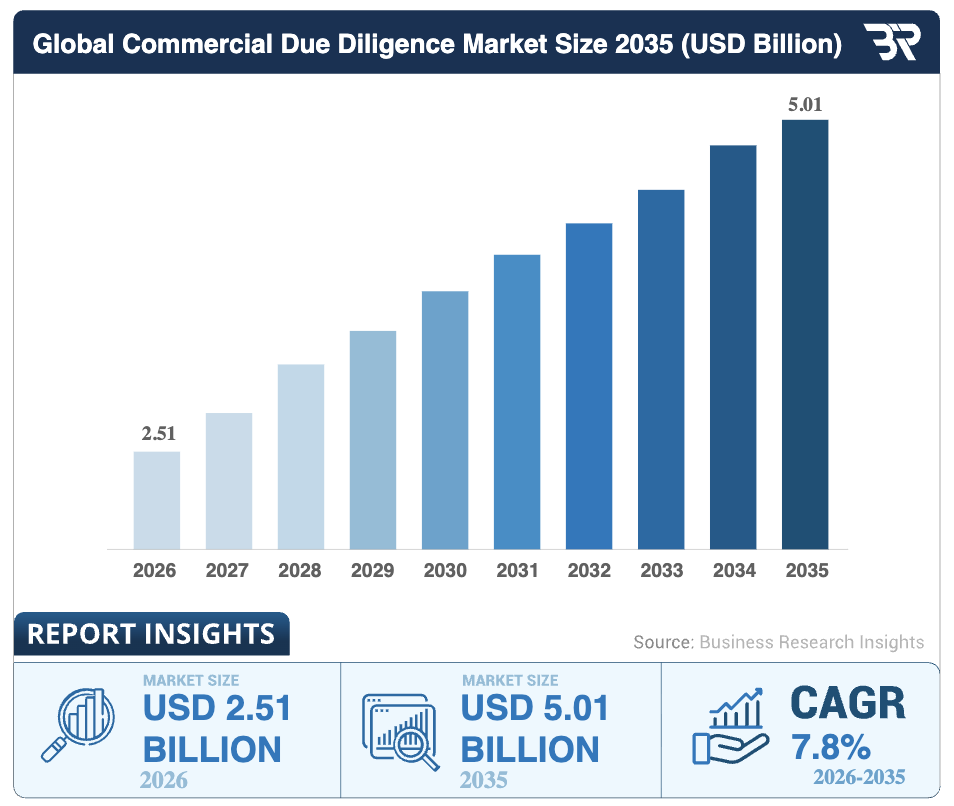
Source: Business Research Insights
“Is The Market Big Enough and Growing for This Plan to Work?”
Investors start commercial due diligence by testing the total market size. They examine credible data sources and segment definitions. Commercial due diligence checks whether the target company defines its addressable market correctly. Inflated TAM figures often weaken confidence in the business plan.
Private equity firms compare growth rates with independent industry benchmarks. They assess segment dynamics and demand stability. Commercial due diligence in private equity focuses heavily on scalability potential. Analysts evaluate whether customer demand supports future potential growth. They also test whether structural trends support sustained expansion. CDD ensures that the opportunity matches the capital deployed.
“Does The Target Have a Defendable Position?”
Commercial due diligence evaluates the target company’s competitive position. Investors map direct competitors and substitute solutions. They test differentiation claims with customer interviews. Private equity firms examine pricing power and switching barriers.
Commercial due diligence identifies strengths that competitors cannot easily copy. Analysts check brand reputation and product advantages. They assess sales execution and channel reach. Commercial due diligence highlights structural advantages rather than temporary wins. Private equity firms need evidence that margins can withstand pressure. A defendable position reduces downside exposure and strengthens valuation confidence.
“Are The Forecasts Credible?”
Commercial due diligence challenges revenue projections with hard evidence. Analysts compare forecasts against historical conversion rates and pipeline data. They test assumptions embedded within the business plan.
Commercial due diligence verifies volume, growth, and pricing assumptions separately. PE firms look for alignment between strategy and execution capability. Analysts question sudden growth spikes without operational support.
CDD examines drivers behind past expansion patterns. It separates market tailwinds from management execution. Investors often rely on commercial due diligence services when internal resources lack sector depth.
Studies show that 68% of due diligence firms use AI-powered analytics tools, reducing manual review time by an average of 35%. A well-prepared virtual data room (global due diligence software) accelerates this review. Clear information flow builds confidence during early evaluation stages.

First Review: What Investors Look For in the First 48–72 Hours
Early review sets the tone for the entire due diligence process. Investors look for clarity and coherence before deeper investigation begins.
The Quick Screening Checklist
Commercial due diligence begins with a rapid information scan. Investors request a concise market overview and segment breakdown. They review customer mix and revenue concentration.
The commercial due diligence process includes pricing logic and competitor mapping. Analysts examine pipeline visibility and recent win rates. They assess how the target company positions itself in sales conversations.
PE firms seek clarity around demand sources. Commercial due diligence flags inconsistencies between claims and data early. This helps investors make more informed investment decisions.
What Triggers Deeper Questions Immediately
Commercial due diligence surfaces doubts during initial screening. Overstated market size often signals weak strategic clarity. Investors question unclear positioning within crowded segments.
The commercial due diligence process highlights churn trends that threaten stability. Heavy reliance on a few accounts increases potential risks. Weak pipeline evidence challenges the credibility of the business plan. Commercial due diligence identifies gaps between reported growth and sales capacity. Early concerns prompt deeper customer referencing and market validation work.
Market Sizing and Growth: Proving the “Opportunity”
Market analysis forms the backbone of commercial due diligence. Investors require evidence that opportunity claims reflect realistic demand conditions.
Define the Market Correctly (Category + Segment Boundaries)
Commercial due diligence tests how the target company defines its market. Investors examine category boundaries and segment logic carefully. Overly broad definitions inflate perceived opportunity.
CDD requires a realistic scope aligned with buying behaviour. Analysts compare definitions with competitor disclosures. They ensure the business plan reflects reachable segments. Clear segmentation improves visibility into future potential growth.
Demand drivers and market tailwinds
Commercial due diligence evaluates structural demand drivers. Analysts study regulation changes and technology shifts. Buyer behaviour trends receive detailed scrutiny. Macro conditions influence expansion potential.
Commercial due diligence in private equity often tests cyclicality exposure. Investors check whether growth depends on temporary stimulus. Sustainable tailwinds strengthen confidence in the target company’s strategy.
Growth Outlook and Limits
Commercial due diligence assesses practical growth ceilings. Market saturation limits share expansion. Pricing pressure reduces margin headroom. Channel constraints slow distribution expansion. Switching costs shape customer acquisition speed.
Commercial due diligence identifies potential risks tied to aggressive share capture. Analysts evaluate competitive responses under different scenarios. A disciplined commercial due diligence process sets realistic expansion expectations.
Commercial Due Diligence Checklist
Use this step-by-step PDF to spot weak market assumptions early, pressure-test revenue drivers, and document findings in a review-ready format.
Customer Reality Check: Who Buys, Why They Stay, Why They Leave
Customer analysis reveals the true strength of revenue streams. Commercial due diligence tests whether loyalty and demand claims hold up under scrutiny.
1. Customer Segmentation That Matters
Commercial due diligence breaks the customer base into meaningful groups. Investors analyse industry exposure and company size distribution. Geographic spread reveals concentration patterns. Use case differences influence retention stability.
Commercial due diligence checks whether the target company serves profitable segments. A focused segmentation supports a coherent business plan.
2. Retention and Concentration Risk
CDD evaluates recurring revenue quality. Analysts measure churn rates across cohorts. Revenue concentration among top accounts receives close review. Private equity firms examine contract duration and renewal terms.
Commercial due diligence identifies potential risks linked to single-channel dependence. Stable retention strengthens investment conviction.
3. Customer Voice Evidence (What Investors Trust Most)
Commercial due diligence relies on direct customer feedback. Interviews test value perception and switching barriers. Customers confirm reasons behind wins and losses.
Commercial due diligence separates marketing claims from real differentiation. Private equity firms value independent validation highly. Insights feed into a comprehensive due diligence report. Reliable customer evidence reduces uncertainty in the target company outlook.
Competitive Landscape: How Investors Test Positioning
Competitive analysis clarifies how the target company wins in practice. Commercial due diligence measures positioning strength under realistic market pressure.
Who The Real Competitors Are
Commercial due diligence distinguishes true competitors from distant peers. Investors identify actual purchase alternatives considered by buyers. Similar companies may not compete in active deals.
Commercial due diligence clarifies substitution threats and price benchmarks. Accurate mapping strengthens the strategic assessment of the target company.
Differentiation That Holds Up Under Pressure
CDD tests the durability of claimed advantages. Analysts review documented win reasons and case studies. Switching friction often protects market share. Clear, unique value propositions support pricing resilience.
Commercial due diligence demands proof beyond management opinion. PE firms require tangible evidence of sustainable positioning.
Market Saturation and Pricing Pressure
Commercial due diligence examines competitive intensity across segments. Crowded markets increase customer acquisition costs. Discounting trends erode margin expansion plans. Longer sales cycles reduce growth velocity.
Commercial due diligence highlights how rivalry affects the business plan. Understanding these dynamics shapes realistic valuation assumptions.
Go-to-Market: Can the Sales Engine Actually Scale?
Growth depends on execution capability and disciplined sales management. Commercial due diligence evaluates whether expansion plans reflect operational reality.
Channels and Acquisition Model
Commercial due diligence evaluates acquisition channels in detail. Investors track inbound sources and partner contributions. Outbound sales effectiveness receives performance scrutiny. Enterprise sales models require longer cycles and higher investment.
Commercial due diligence checks whether the channel mix supports scaling. The target company must show repeatable demand generation systems.
Sales Cycle and Pipeline Reliability
Commercial due diligence analyses defined pipeline stages and metrics. Conversion rates reveal execution discipline. Sales velocity indicates operational efficiency.
The commercial due diligence process tests historical close ratios. Analysts compare projected bookings against capacity limits. Reliable pipeline data supports confidence in the business plan.
Sales & Marketing Efficiency Signals
Commercial due diligence reviews customer acquisition cost logic. Investors examine payback periods and lifetime value assumptions. Marketing spend discipline signals management quality.
CDD identifies potential risks from aggressive expansion spending. Strong efficiency metrics strengthen trust in future potential growth.
Pricing and Revenue Quality: Will the Model Hold?
Revenue durability depends on pricing strength and disciplined execution. Commercial due diligence evaluates whether growth reflects real economic value.
Pricing Architecture and Discounting Behavior
Commercial due diligence evaluates list pricing structures carefully. Analysts compare stated prices with realised net revenue. Frequent discounting signals weak pricing power.
CDD checks approval controls for price reductions. Stable pricing discipline supports margin durability within the target company.
Revenue Drivers
Commercial due diligence decomposes revenue growth components clearly. Analysts separate volume expansion from pricing impact. Product mix shifts influence average revenue per customer.
For example, commercial real estate due diligence follows similar logic when rent growth claims arise. Commercial due diligence ensures growth reflects execution strength rather than temporary tailwinds.
Forecast Validation: Turning “Plan” Into Evidence
Forecast testing transforms ambition into measurable expectations. Commercial due diligence challenges every major assumption within the business plan.
1. Assumptions Investors Test First
Commercial due diligence verifies forecast assumptions against historical data. Analysts compare projections with actual sales productivity trends. The commercial due diligence process tests consistency with market benchmarks. Investors challenge optimistic penetration targets. It also ensures alignment between strategy and operational capacity. Evidence must support every major revenue driver within the target company.
2. Scenario Thinking (Base/Downside)
Commercial due diligence builds base and downside cases. Analysts stress test churn sensitivity and pricing compression. Slower growth scenarios expose structural weakness. Commercial due diligence quantifies the impact on cash flow stability. Private equity clients use this analysis to structure protection mechanisms. Transparent scenario modeling reduces exposure to unforeseen potential risks.
Red Flags That Change the Investment Thesis
The following are red flags usually uncovered during the CDD process.
- Overstated market size signals weak strategic understanding and unrealistic positioning assumptions.
- Unclear segment focus creates confusion around customer targeting and growth priorities.
- Competitive advantage based on opinion lacks proof from customer evidence or win data.
- Pipeline data that conflicts with reported revenue trends reduces the credibility of forecasts.
- Heavy reliance on a few customers increases concentration exposure and earnings volatility.
- Dependence on one acquisition channel limits resilience during market disruption periods.
- Forecasts that require perfect execution ignore operational constraints and market pressure.
- Weak differentiation within crowded markets increases pricing pressure and churn risk.
- Rapid growth without sales capacity expansion signals structural execution gaps.
How Commercial Findings Shape the Deal
Deal outcomes reflect the strength of validated market evidence. Commercial due diligence directly influences price negotiation and structural protection.
1. Valuation Impact
Commercial due diligence directly influences valuation multiples. Strong evidence of demand expansion supports premium pricing. Weak positioning reduces confidence in sustainable margins. Commercial due diligence in private equity often shifts negotiation leverage. PE firms adjust offers based on validated growth durability. Lower certainty around expansion reduces valuation tolerance.
2. Deal Structure Adjustments
Commercial due diligence findings shape structural protections. Earn-outs link payment to verified performance milestones. Staged investment reduces upfront exposure. Tighter warranties address identified potential risks. The commercial due diligence process informs these adjustments clearly. Structured safeguards protect downside exposure for private equity firms.
3. Value Creation Plan Inputs
CDD also helps set post-acquisition priorities. Insights highlight segmentation gaps and channel weaknesses. Go-to-market improvements often follow early findings. A commercial due diligence report creates a roadmap for operational focus. The target company benefits from a clearer strategic direction. Outputs integrate directly into the revised business plan.
Commercial Due Diligence Checklist
The following should be part of every commercial due diligence process.
- Detailed market size model with clear segment boundaries and realistic demand assumptions
- Customer list organised by segment with transparent concentration and revenue distribution view to provide detailed customer insights.
- Competitive landscape mapping that identifies real purchase alternatives and pricing benchmarks
- Positioning summary that explains clear differentiation supported by customer validation evidence
- Pricing model overview with documentation of discount levels and approval controls
- Go-to-market structure summary, including channel mix and defined sales responsibilities
- Sales funnel metrics covering conversion rates and average sales cycle length
- Forecast model with explicit assumptions aligned with historical performance evidence
- Sensitivity analysis outlining downside exposure under slower growth scenarios
- Customer feedback summary that validates the value proposition and switching barriers
Final Takeaways
Commercial due diligence shows whether market demand is real, resilient, and capable of supporting sustainable growth. Investors look for defendable positioning backed by credible, verifiable evidence, and they expect forecasts to be grounded in measurable performance data rather than optimistic assumptions. For private equity teams in particular, disciplined analysis is a prerequisite before committing meaningful capital, and it helps confirm whether the target’s expansion plans are realistic and achievable.
When the process is structured and well-documented, it reduces uncertainty and improves decision confidence across stakeholders. Organising the supporting materials in a virtual data room adds transparency, speeds up review cycles, and keeps the transaction moving. Strong preparation also shortens timelines and enables more balanced negotiations—turning strategic ambition into investment logic that is credible, defensible, and easier to underwrite.